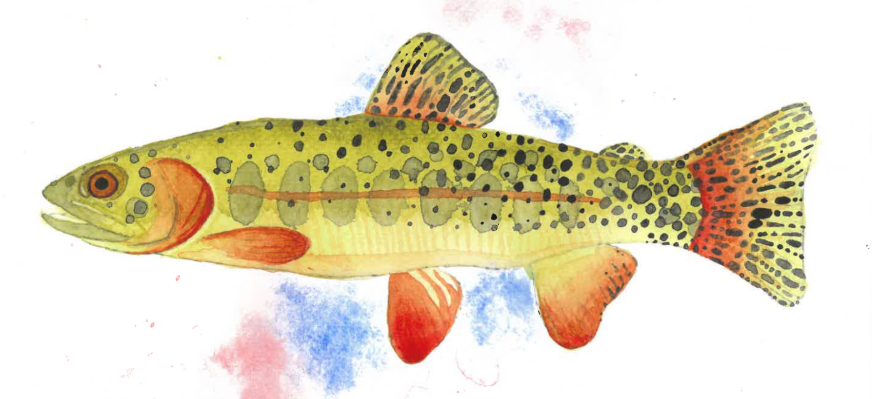
The Greenback Cutthroat Trout has endured one of the most dramatic conservation journeys of any species in the American West. Once presumed extinct, later rediscovered in an unexpected mountain stream, and now the focus of intensive restoration efforts, the Greenback Cutthroat conservation story mirrors the broader evolution of American fisheries management.
Colorado's State Fish
My introduction to the Greenback Cutthroat Trout didn’t come from hours of watershed research, hooking into a fish in a Colorado stream, or stumbling across a YouTube video of fly fishing in the Front Range. Instead, it happened at work, while chatting with an intern from the Leadville National Fish Hatchery who was participating in the U.S. Fish and Wildlife Service’s former Directorate Fellowship Program. Evan had been selected from a large pool of candidates to join a cohort of twenty or so students, each promised hands‑on training and research experience to prepare them for careers in the federal conservation workforce.
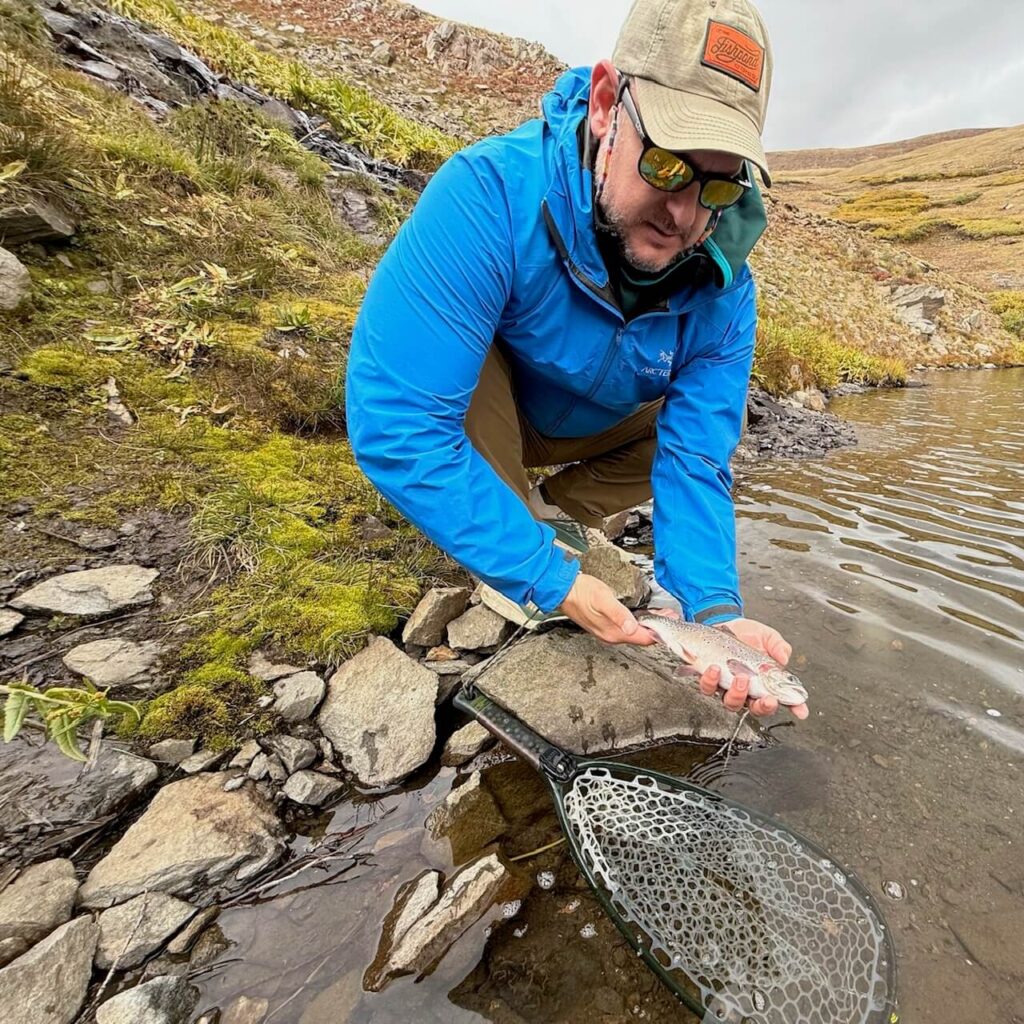
I was immediately intrigued by the genetic research, careful fish‑rearing practices, public education, and interagency collaboration that Evan described from his summer internship. Before long, my professional curiosity had grown into a personal desire to learn more about this subspecies of cutthroat—and eventually, to try to bring one to hand from its native range here in Colorado. My hope is to broaden your understanding of the remarkable history and ongoing work that has gone into supporting Colorado’s state fish.
The history of aquatic conservation in the United States is shaped by shifting scientific understanding, changing cultural values, and the persistent work of the U.S. Fish and Wildlife Service, Colorado Parks and Wildlife, Trout Unlimited, and countless organizations and private citizens. The conservation history of the Greenback Cutthroat Trout reveals how mistaken assumptions, scientific breakthroughs, and interagency collaboration have shaped the fate of a species once nearly lost to time.
Decline of Colorado's Native Cutthroat Trout
Before Euro‑American settlement, the Greenback Cutthroat Trout occupied the cold, clear waters of the South Platte River basin, where it played a central ecological role and supported Indigenous communities. This balance unraveled rapidly in the late nineteenth century as mining runoff, deforestation, agricultural development, and unregulated water diversion degraded streams throughout the Front Range. As Chris Kennedy notes in America’s Bountiful Waters, these pressures coincided with a national enthusiasm for fish stocking, driven by the belief that American waters could be “improved” through the introduction of hardy, fast‑growing species. Colorado Parks and Wildlife echoes this history in its species profile, noting that widespread stocking of non‑native trout fundamentally altered the genetic landscape of native cutthroat populations. Trout Unlimited has similarly described how early stocking practices and habitat degradation created “a perfect storm” for hybridization and displacement of native trout across Colorado’s high‑country streams.
By the early twentieth century, the Greenback Cutthroat Trout had vanished from most of its historical range. By the mid‑1900s, biologists believed the species was extinct. Surveys failed to locate genetically pure populations, and the species was formally listed under the Endangered Species Act in 1973. The U.S. Fish and Wildlife Service’s original listing documents describe the species as functionally extirpated across its native waters. Yet the search continued. Throughout the 1950s–1970s, state and federal biologists scoured remote headwater streams, hoping to find remnant lineages. Several populations were identified as “greenbacks,” and early recovery plans were built around these fish. These efforts reflected the best available science of the time, even though the tools for distinguishing subspecies were limited. Colorado Parks and Wildlife’s early recovery reports show how much effort went into protecting what were believed to be the last survivors.
A Genetic Revelation
Everything changed in 2012. Researchers using modern DNA analysis discovered that nearly all presumed “greenback” populations were actually other cutthroat subspecies—Colorado River or Rio Grande lineages that had been misidentified for decades. The landmark study by Metcalf and colleagues confirmed that the only genetically pure Greenback Cutthroat Trout survived in a single, isolated population in Bear Creek, west of Colorado Springs. This revelation reshaped the entire recovery effort. It forced agencies to rewrite management plans, re‑evaluate hatchery stocks, and confront the reality that the species was far rarer than previously believed. Yet it also provided clarity: for the first time, conservationists knew exactly which lineage they needed to save.
Armed with this new genetic understanding, federal and state agencies launched a coordinated effort to restore the Greenback Cutthroat Trout to its native waters. Habitat restoration became a central focus: streams were rehabilitated, non‑native trout were removed, and barriers were installed to protect reintroduced populations from hybridization. The U.S. Fish and Wildlife Service’s hatchery system—a cornerstone of national conservation—played a crucial role in propagating the Bear Creek lineage. Leadville National Fish Hatchery reports describe the painstaking broodstock management and genetic verification required to maintain the lineage’s purity. The U.S. Forest Service has also documented extensive watershed restoration efforts in areas like Herman Gulch and Dry Gulch, where reintroductions have taken place.
These hatchery‑raised fish are now being reintroduced into carefully selected streams within the South Platte basin. The work is slow and complicated by wildfire, drought, disease, and the ongoing effects of climate change, but the species is steadily reclaiming parts of its historical range.
The U.S. Fish and Wildlife Service’s hatchery system—a cornerstone of national conservation—played a crucial role in propagating the Bear Creek lineage. Leadville National Fish Hatchery reports describe the painstaking broodstock management and genetic verification required to maintain the lineage’s purity. The U.S. Forest Service has also documented extensive watershed restoration efforts. Hatchery‑raised fish are now being reintroduced into carefully selected streams within the South Platte basin. The work is slow and complicated by wildfire, drought, disease, and the ongoing effects of climate change, but the species is steadily reclaiming parts of its historical range.

Lessons From the Greenback Cutthroat Conservation Story
The conservation history of the Greenback Cutthroat Trout underscores the importance of accurate science in wildlife management. Decades of misidentification show how easily well‑intentioned efforts can go astray without the right tools. At the same time, the species’ recovery demonstrates the power of collaboration among federal agencies, state biologists, academic researchers, and local communities. Trout Unlimited emphasizes that Greenback recovery has become one of the most collaborative fisheries projects in the Rockies, involving volunteers, land managers, and scientists working side by side. Colorado Parks and Wildlife similarly highlights the role of partnerships in its recovery planning documents. The Greenback’s story also highlights the complexity of restoring native species in ecosystems transformed by human activity—a challenge that will only grow in the face of climate change.
From presumed extinction to genetic rediscovery to ongoing restoration, the Greenback Cutthroat Trout’s journey reflects the dynamic and sometimes messy history of American conservation. Its survival is a testament to scientific progress, institutional persistence, and the enduring value placed on native species. But for me, the story has become more than a case study in conservation. What began as a casual conversation with an intern at the Leadville National Fish Hatchery has grown into a deeper appreciation for the people, science, and history behind this fish.
Every time I step into a cold Colorado stream, I’m reminded that the Greenback’s return is not guaranteed—it’s the result of decades of work by biologists, volunteers, and agencies determined to give this trout a future. As Colorado continues working to restore the Greenback to its rightful waters, the species stands as both a conservation success in progress and a reminder of the responsibility we all share to protect the ecological heritage of the American West.
Learn More About Greenback Cutthroat Conservation
From the U.S. Fish and Wildlife Service: www.fws.gov/project/greenback-cutthroat-trout-research-and-recovery
From Colorado Parks and Wildlife: cpw.state.co.us/species/greenback-cutthroat-trout
From Trout Unlimited: coloradotu.org/greenback-cutthroat-recovery-efforts
From the Greenback Trout Recovery Team: westernnativetrout.org/wp-content/uploads/2019/07/gbnrecoveryplan-1998.pdf


